
Ovarian Cancer Surgery: Is It Better Before or After Chemotherapy?
Bixel K, Olawaiye A, Flanigan M, et al. Now or Later? Defining the Ideal Time for Surgical Cytoreduction in Advanced Ovarian Cancer. ASCO Educational Book, 2026. See the MedPage Today overview and PubMed record
For people diagnosed with advanced ovarian cancer, surgery and platinum-based chemotherapy are both important parts of treatment. One of the most difficult decisions is determining which should come first.
A recent review published in the ASCO Educational Book examined the evidence comparing two commonly used treatment approaches:
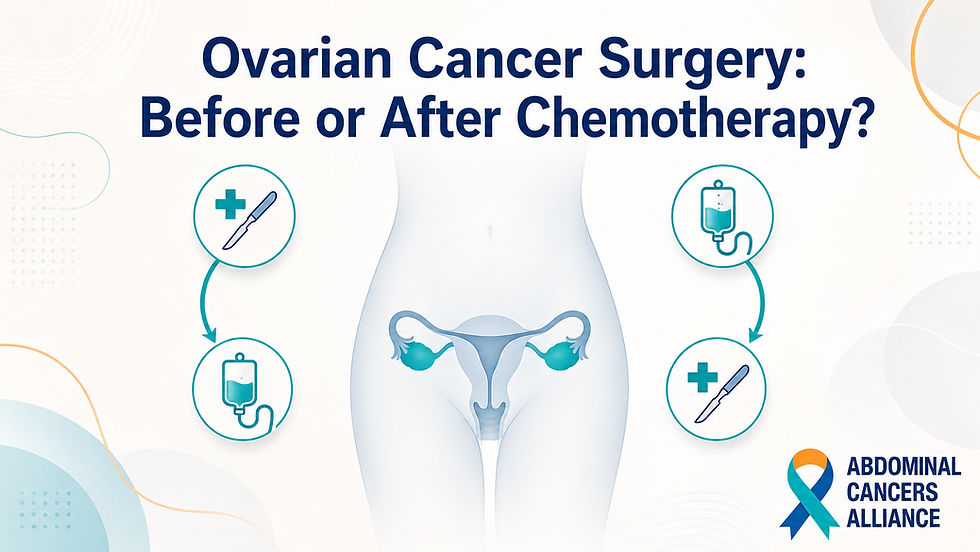
Primary cytoreductive surgery: Surgery is performed first, followed by chemotherapy.
Neoadjuvant chemotherapy and interval surgery: Chemotherapy is given first to shrink or control the cancer, followed by surgery and additional chemotherapy.
The authors found that there is no single approach that is best for every patient. Instead, the most important goal is selecting the treatment sequence most likely to achieve complete cytoreduction—the removal of all visible cancer—while keeping the patient safe.
Why Does the Timing of Surgery Matter?
Advanced ovarian cancer often spreads throughout the abdominal cavity. Cytoreductive, or “debulking,” surgery may involve removing tumors from several organs or surfaces within the abdomen.
When surgeons believe all visible cancer can be safely removed at the beginning of treatment, primary surgery may be recommended. However, surgery may not be the best first step when the cancer is too extensive to remove completely, when the operation would carry significant risks or when the patient needs time to become medically stronger.
In these situations, chemotherapy may be given first. After several cycles, the medical team reassesses whether interval cytoreductive surgery is likely to be safe and successful.
What Has Previous Research Shown?
Several major clinical trials have compared primary surgery with chemotherapy followed by interval surgery. Earlier trials, including EORTC 55971 and CHORUS, found that beginning with chemotherapy produced survival outcomes that were not worse than beginning with surgery. Patients receiving chemotherapy first also generally experienced fewer serious surgical complications.
However, these studies raised questions about the quality and extent of surgery performed and the relatively low rates of complete tumor removal. This made it difficult to determine whether primary surgery might produce better outcomes when performed by experienced gynecologic oncology teams capable of carrying out complex procedures.
More recently, the TRUST trial compared primary surgery with neoadjuvant chemotherapy at centers selected for their surgical expertise. Median overall survival was 54.3 months for patients assigned to primary surgery and 48.3 months for those assigned to chemotherapy first. The difference was not statistically significant, meaning the study did not establish that one treatment sequence was superior to the other.
The findings reinforced another important message: patients whose surgeons achieved complete cytoreduction had better outcomes, regardless of when the surgery occurred.
Complete Cytoreduction Remains the Main Goal
Across the available research, the amount of cancer remaining after surgery is one of the strongest predictors of patient outcomes. “Optimal debulking” was historically used to describe leaving tumors measuring no more than one centimeter. Today, specialists increasingly aim for no visible residual disease whenever it can be achieved safely.
This does not mean every patient should undergo an aggressive operation immediately. Attempting extensive surgery when complete removal is unlikely may expose a patient to complications without providing the same potential benefit.
The decision should consider:
The location and amount of cancer
Whether all visible disease appears removable
The complexity of the surgery that would be required
The patient’s overall health, nutritional status and ability to recover
The experience of the surgical team and treatment center
How urgently systemic treatment is needed
The patient’s goals and preferences
Imaging, physical health assessments and sometimes diagnostic laparoscopy may help the care team determine whether surgery should happen before or after chemotherapy.
Why Specialized Care Matters
Complex ovarian cancer surgery requires significant expertise. Outcomes may be influenced not only by the treatment sequence but also by the experience of the surgeon and center performing the operation.
Evaluation by a gynecologic oncologist who regularly treats advanced ovarian cancer can help patients understand whether complete cytoreduction appears possible and whether chemotherapy should be given first. A multidisciplinary team can also bring together expertise in surgery, medical oncology, radiology, pathology, anesthesia and supportive care.
When the recommended approach is unclear—or when a patient is told that surgery is not possible—seeking a second opinion at a high-volume gynecologic cancer center may provide additional information.
What This Means for Patients
The review does not identify one universally “correct” time for ovarian cancer surgery. Instead, it supports an individualized approach based on both the extent of the cancer and the patient’s ability to undergo a major operation.
For some patients, surgery before chemotherapy may offer the best opportunity to remove all visible disease. For others, chemotherapy followed by interval surgery may provide a safer and equally appropriate path.
The central question is not simply whether surgery happens first or later. It is whether surgery can safely achieve complete removal of visible cancer—and whether the patient is receiving care from a team with the expertise to make that assessment.
Patients may wish to ask their care team:
Do you believe all visible cancer can be removed with surgery?
What findings support surgery first or chemotherapy first in my case?
How often does this center achieve complete cytoreduction?
Would diagnostic laparoscopy help evaluate whether surgery is possible?
What are the potential benefits and risks of each treatment sequence?
Should I seek a second opinion from a gynecologic oncologist at a specialized center?


