
The Dragon and the Lens: A Mother’s Journey Through Appendix Cancer
I have always been a pragmatist, a teacher of English Literature who looked for logic in the narrative arc of a story. But nothing in the great works of fiction could have prepared me for the moment the story became my own—or more accurately, my son’s.
My son, “Hunter”, is 43, a gifted cinematographer living in Tulsa. He sees the world through a lens of light and shadow, but in 2023, a shadow fell over us that no camera could filter out. It began with standard abdominal pain and an emergency appendectomy. We thought the crisis was over. Then came the phone call that fractured my world:
"Mom, I just looked at my health portal... I’ve got cancer."
At first, I simply didn't believe him. As a mother, your heart has a built-in shield that refuses to accept the unthinkable. But the pathology report was undeniable: Goblet Cell Adenocarcinoma (GCA), a rare and aggressive form of appendix cancer. It was Grade 2, perforated, with positive margins.
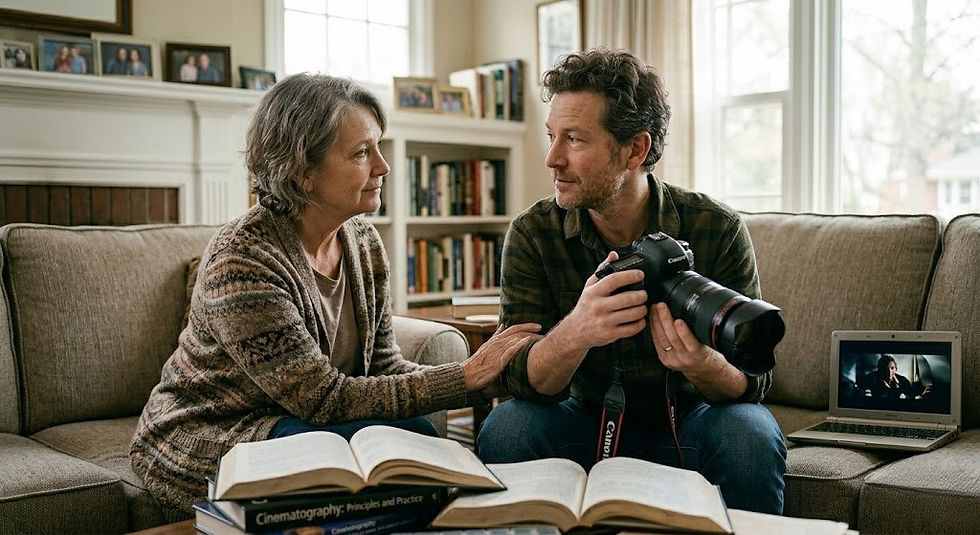
The Weight of the Fight
While Hunter remained strangely calm, my own anxiety began running on all cylinders. He may be an adult, but he is still my child, and I found myself preparing to slay the world’s largest dragon to defend his life. I was still teaching high school at the time, and trying to maintain a professional demeanor which felt nearly impossible. In a small town, news travels fast; soon, my students were the ones offering me support. Their quiet kindness became the grace that held me together while I spent every spare second researching a disease that had only been distinguished from colon cancer in the last twenty years.
Finding a Tribe in Houston
Our search for answers led us to MD Anderson in Houston. There, the news grew heavier - the pathology was upgraded to Grade 3. Yet, walking through those hospital halls was life-changing. We saw a three-year-old battling eye cancer and a 29-year-old named Sam fighting the same rare beast as Hunter. You might expect such a place to be depressing, but it was uplifting. We were just two faces in an auditorium of suffering, but in every face, there was hope. We weren't alone.
In August 2023, Hunter underwent surgery to remove half of his colon. The tumor board recommended chemotherapy, but it offered only a 5% increase in survival—at the cost of potential nerve damage to his hands. For a cinematographer, his hands are his life. I struggled with his choice to decline chemo, but I chose to honor his dignity and support his decision.
Parallel Paths
During our time in Houston, I met Jane, whose son, Sam, was undergoing the same surgery a day before Hunter. We shared a glass of wine and the heavy silence that only parents of sick children understand. Our sons’ paths diverged in the way only cancer can dictate: Hunter’s lymph nodes were clear, but Sam’s were not. Over the next year, I watched from afar as Sam fought aggressively, through trials and failures, until he passed away quietly at age 30. That loss sits heavy on my heart. It is a reminder of how fragile this journey is.
The Long Breath
Today, Hunter’s scans are clear. We live our lives in six-month increments, waiting for the next scan, praying for the five-year mark. Only then, I think, will I finally be able to breathe again. Until then, I stay in the support groups, I keep researching, and I keep watch.
Words of Advice for the Caregiver’s Soul
If you find yourself unexpectedly drafted into the role of a "dragon-slayer," here is what I have learned from the trenches:
Trust Your Instincts, then Find the Experts: Don't settle for standard care for a rare condition. Seek out specialists who treat your specific diagnosis every day.
Community is the best antidote to the isolation of illness: You may be used to being the strong one, but let your neighbors, friends, and whoever shows you they care about you carry you. Community is the best antidote to the isolation of illness.
Research and Knowledge is an Anchor: Read the reports and join the support groups. Understanding the terminology won't take the cancer away, but it will give you the agency to ask the right questions.
Respect the Patient’s Sovereignty: Your loved one’s choices may terrify you—especially regarding quality of life versus length of life. Your job is to provide the data, but your most important job is to provide the support, regardless of their final decision.
Find Your "Janes" - Connect with someone walking the same path. Only another parent or caregiver truly knows the weight of the silence after the phone hangs up.
To all the caregivers: You are stronger than you feel, and even in the darkest pathology, there is a community waiting to hold your hand.


