
Seeing What CT Scans Can Miss: Improving Peritoneal Cancer Staging Before Surgery
Guerrero-Macías S, Ávila-Rodríguez V, Urrutia-Gómez JA, et al. Concordance Among Radiological, Laparoscopic and Laparotomic Peritoneal Cancer Index Assessments in Patients Undergoing Cytoreductive Surgery for Peritoneal Metastases. Ann Surg Oncol. 2026. doi:10.1007/s12029-026-01538-3. PMID: 42541526.
What did the researchers study?
Researchers wanted to determine how accurately different methods of measuring the Peritoneal Cancer Index (PCI) estimate the amount of cancer that has spread throughout the abdominal lining. The PCI is an important tool that helps surgeons decide whether a patient with peritoneal metastases may benefit from cytoreductive surgery (CRS).
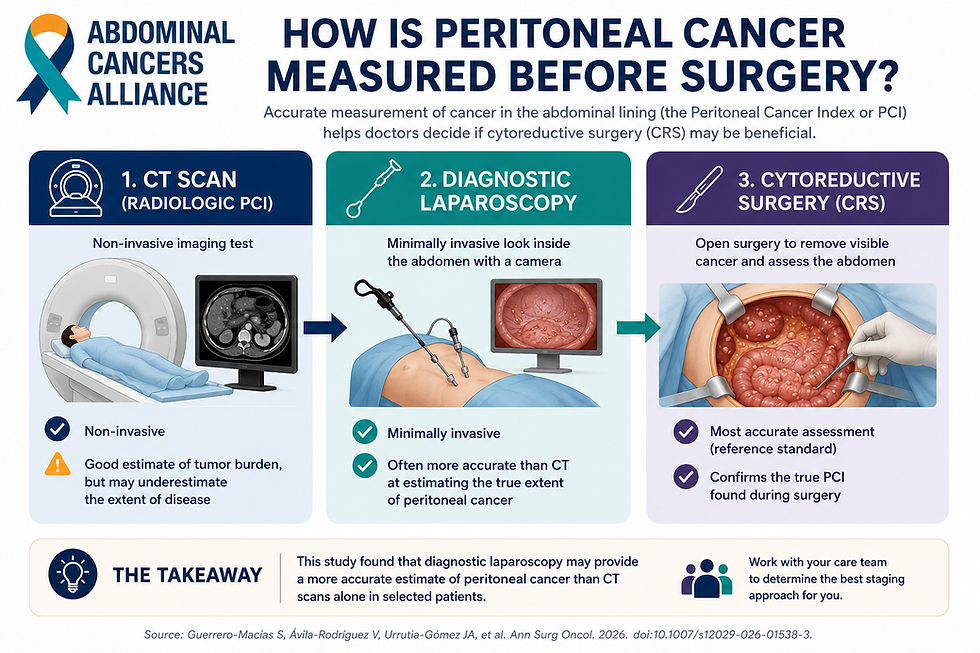
The study compared PCI scores obtained from:
CT imaging before surgery (radiologic PCI)
Diagnostic laparoscopy (a minimally invasive procedure using a camera)
Open surgery, which served as the reference standard
What did they find?
The researchers found that CT scans provided a reasonable estimate of tumor burden but often underestimated the amount of cancer that was actually present during surgery. In the smaller group of patients who also underwent diagnostic laparoscopy, laparoscopic PCI more closely matched the findings seen during surgery than imaging alone.
Because only 16 patients underwent laparoscopy—and most had gastric cancer—the researchers cautioned that these findings should not be applied to all patients with peritoneal metastases.
Why does this matter?
Accurately measuring the extent of peritoneal disease is critical when deciding whether cytoreductive surgery is likely to be beneficial. This study suggests that while CT imaging remains an important first step, diagnostic laparoscopy may provide additional information in selected patients, especially when imaging results are unclear or when the extent of disease is uncertain.
More accurate staging may help patients and their care teams make better-informed treatment decisions and avoid unnecessary surgery.
Key Takeaways
CT scans are useful for estimating the extent of peritoneal metastases but may underestimate the amount of disease.
Diagnostic laparoscopy more closely reflected the amount of cancer found during surgery in this study.
Laparoscopy may be especially helpful when imaging results are unclear or when surgeons need additional information before proceeding with cytoreductive surgery.
Because this was a small, single-center study, larger studies are needed to confirm which patients benefit most from laparoscopic staging.
Patients should discuss with their care team which staging tests are most appropriate for their individual situation.


